To Ethnos, Athens – Cartoon. See more.
I Kathimerini, Athens – Cartoon. See more.
El País, Madrid – The year 2012 seemed pretty dangerous for the eurozone and the whole of the EU. But the worst did not come to pass, especially since Angela Merkel made concessions, which allowed Mario Draghi, President of the ECB to intervene. However, in 2013, Europeans will still have to remain vigilant. See more.
The 30th EU-Russia Summit, held in Brussels on December 20-21 highlighted the differences opposing the two partners. These range from the attitude towards Syria, energy policy and human rights, through to Iran, the Arab Spring and trade. All of these subjects were carefully avoided at the dinner on Thursday between Russian President Vladimir Putin, the President of the EU Council, Herman Van Rompuy, and the President of the EU Commission José Manuel Barroso, but they returned to the table – notably energy and trade – on Friday during a meeting with the leaders of the 27 member states.
The mood is made even more oppressive, notes The Guardian, by the fact that Putin seems deaf to Europe’s calls for greater democracy and because the European Parliament adopted a resolution on December 13, calling for an end to persecution, arrest and detention for political reasons.
In the EUobserver, researcher Dan Steinbock says recent trade tension between Brussels and Moscow is likely to strain the meeting, but both sides must overcome their differences and “agree to disagree”. He writes –
In the post-crisis environment, old bargaining positions no longer hold. From the EU standpoint, Russia’s energy power will decline over time. In Russian view, Brussels no longer has either economic might or moral pretext to lecture to Moscow.
He adds that while the EU will remain reliant on Russian energy supplies, recent shale gas discoveries may alter the global balance of energy power, adding –
In the long run, the relative economic and strategic importance of both the EU and Russia will decline in the world economy. The real question is whether Russia or the EU will be the first to embrace the multipolar future – and the requisite tradeoffs.
This view is shared by French daily Le Monde, which says that the Brussels meeting is between „two regions each suffering from an identity crisis“ –
The EU is torn between its peoples’ resentment, exhausted by the crisis, and the need for bold political and budgetary integration. Russia, for its part, is stagnating, tensing up because it does not know where to go.
Le Monde adds that –
supporters of closer ties between the EU and Russia put forth the common interests, the energy cooperation, the crossed investments and the cultural similarities. They pretend not to see the chasm growing between these two bodies concerning values.“ Russia forces Europe to face this question: to what European construction can we aspire if we refuse to protect its foundations?
Mostly, Le Monde notes that „Russia is not the West. And it no longer wants to be.“
The economic crisis in Europe and in the United States has convinced it to seek role models elsewhere. But Moscow remains incapable of defining in positive terms the path it has chosen. The regime sees the world as unstable and dangerous.
De Standaard, Brussels – According to the European Court of Auditors, it’s almost impossible to check how EU aid money is spent by developing countries. As a major EU aid fraud scandal hits Uganda, commentators in Kampala wonder why European donors continue to funnel cash into a corrupt country. See more.
Le Monde, Paris – The new year will be busy for Ivo Josipović, the President of Croatia. For one, his country will join the European Union on July 1, 2013. That means this atypical head of state, who is both a lawyer and a composer, will have to wait a while longer before returning to his piano to finish an opera about John Lennon. See more.
The Economist, London – Cartoon. See more.
The proposed revision of the European directive on tobacco, presented on December 19 in Brussels, has provoked strong reactions in Sweden. In effect, the text upholds the prohibition on tobacco for oral use, or snus, which is highly popular with Swedes, declaring that “health warnings” similar to those imposed on cigarette packets must be visible on the boxes, and also keeps in place the prohibition against adding flavours. Although Sweden benefits from a exemption from the ban on producing and selling snus, it still cannot export the product – the flagship of its tobacco industry.
Aftonbladet accuses the Swedish government of failing to protect the exemption on snus, “occupied as it has been in trying to get permission to export,” under pressure from the tobacco lobby.
Fredrik Reinfeldt will now go down in history as the prime minister who has taken their snus away from the Swedes. If Swedish politicians want more success in the future, they must change their strategy. The priority must be the protection of the Swedish exemption. The desire of the tobacco industry to open up new markets must drop into second place.
In Expressen the philosopher Lars Gustafsson attacks the “authoritarian language of the European Commission”, which wants to dictate “what flavour snus will have and to where it will be exported.” It is even, he says, „a crucial issue for democracy…. But that is not the issue.“ He writes –
It is no longer a philosophical question about whether an organisation incapable of coming up with a coherent policy to stop global warming should intervene in how consumers in member states should take their snus. No. What matters is to tell Barroso [President of the European Commission] that he is nothing more than a lackey. And that he cannot ignore our trade minister, who, unlike him, does have democratic legitimacy. Where does Barroso draw his legitimacy from?
“Pierre Schellekens is the head of the European Commission office in Stockholm. And he takes snus”, the daily writes in its editorial
M. Schellekens will soon be sending a report to Brussels on the growing scepticism in Sweden towards the EU and the negative image of the EU bureaucrats who want to regulate our snus in detail and prohibit its flavouring.
In many ways, European cooperation is a fantastic invention. But it is precisely this type of stupid proposal that erodes popular commitment to the Union – this outstanding incapacity to distinguish between big and small matters.
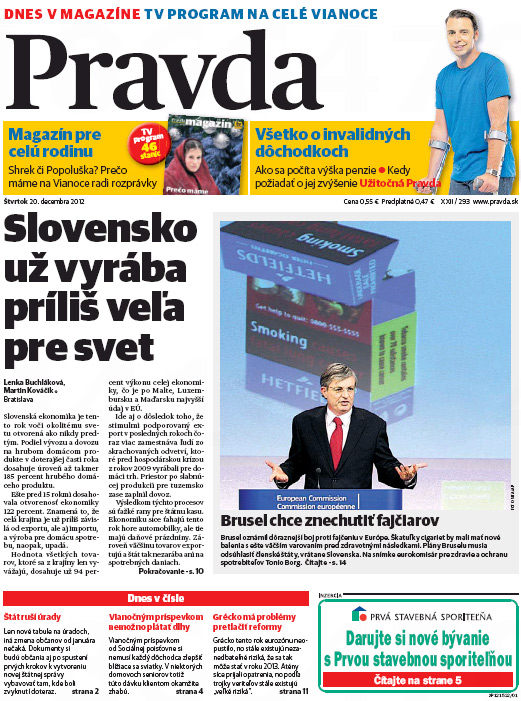
“Slovakia is already producing too much for the world,” writes Pravda on its front page. Exports from the country now stand at 94 per cent of GDP, a ratio that makes Slovakia one of the highest-exporting member states of the EU after Malta, Luxembourg and Hungary, and one of the most open countries in the world in terms of trade, writes the newspaper. The Slovak economy is supported by the automotive sector. In 2012, 850,000 cars will roll off the production lines, or 157 per 1,000 inhabitants. The newspaper adds –
These two records should, in theory, be a cause for celebration. If we look closely, though, we find much food for thought there, for both records show a huge dependency and vulnerability in the economy.
The newspaper warns against the risk of becoming the „Detroit of the East“ – a ghost town like those in the United States, if this single industry should one day disappear.
Economists point out that Slovakia’s economic growth is purely on paper: it does not reduce unemployment and does not fill up the state coffers. As the automakers benefit from low tax rates, and most of the production is exported, Slovakia does not benefit from taxes on the sales of the cars. The country is too dependent on trade and produces very little for the domestic market. Accordingly, Pravda notes,
there is no quick fix for reducing the exposure of the market. The only way forward is to create favourable conditions for local businesses and move to areas with higher added value.