
El País, Madrid – The "Men in Black," or Troika of lenders from the International Monetary Fund, the European Central Bank and the European Union, who offer bailouts in exchange for austerity, have become a source of humour. It is the basis of a new card game and advertisement, but the laughter hides fears that the situation will deteriorate in 2013. See more.
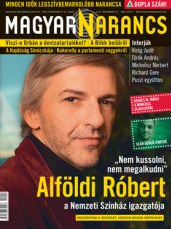
“I won’t keep my mouth shut or make deals with the enemy,“ says the Director of the National Theatre on the front page of Magyar Narancs, explaining that he will continue to fight his fight in the Kulturkampf raging through Hungary today. Róbert Alföldi, whose term runs out in 2013, will be replaced by Attila Vidnyánszky, close to the government of Viktor Orbán, which is accusing Alföldi of not doing enough to represent Hungary’s national values. Also, for several months, the far right has been criticising Alföldi’s lack of patriotism and denouncing his homosexuality. “But then, what was not ‘national’ about the theatre under Alföldi?” protests the liberal weekly. “And who are you to prescribe our national values? Who are you to doubt the national sentiments of anyone else?
“In Hungary, the notion of pluralism differs from that in western Europe” says the leftist daily Népszava:
We knew in advance Attila Vidnyánszky would become director of the National Theatre. Under normal conditions, Róbert Alföldi would likely have had the opportunity to continue his successful work. But the leaders put people close to themselves on the nine-member board that decides on director positions. That’s the problem.
However, for the right-wing daily Magyar Nemzet, the change of direction imposed by the government is a good thing.
The appointment of Vidnyánszky will help to get across the meaning of the word ‘national’ to those who, so far, do not seem to get it…’
Frankfurter Allgemeine Zeitung, Frankfurt – A German trauma therapist journeys to Greece. What he sees there surpasses his worst fears. Greek society is crumbling under the pressure of the crisis. See more.
Dnevnik, Sofia – After Athens, it’s Sofia’s turn to put the brakes on the opening of EU accession negotiations with Macedonia. It’s a stance that’s stirring up nationalist tensions between the two countries and breathing new life into the clichés of its European partners about the bickering Balkans, regrets a Bulgarian journalist. See more.
Jurnalul Naţional, Bucharest – Cartoon. See more.
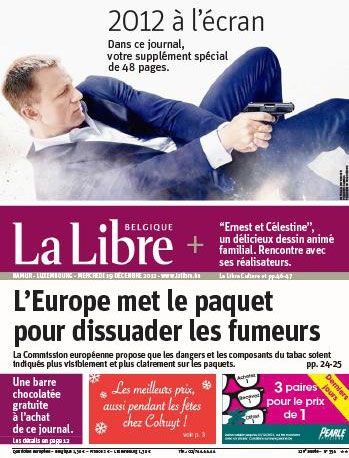
„Europe goes all out to dissuade smokers,“ runs a front page headline in Belgian daily La Libre Belgique, anticipating the December 19 unveiling of a European Commission directive on „the manufacture, presentation and sale of tobacco“.
The directive, to which several media outlets had access, will increase the space occupied by health warnings from 40 percent to 75 percent, on both sides of packets of cigarettes and rolling tobacco.
French financial daily Les Echos, however, compares „this barrage of anti-tobacco measures“ taken by the Commission to those enacted Down Under on December 1st —
We are not yet Australia, where all the packets are now identical and devoid of logos. But the [EU] directive gives states the possibility to toughen the measure. Four countries, including France, the United Kingdom and Belgium, are said to show interest in the Australian example.
The directive should also ban certain flavours (such as menthol) or so-called „slim“ cigarettes thought to encourage consumption. This has raised the ire of the very powerful tobacco industry lobby which sought to make itself heard as the directive was being drafted — a state of affairs that came to public attention in October 2012 when the EU Health Commissioner John Dalli was forced to resign amid allegations of influence peddling.
For Italian daily La Stampa, however, the outraged reaction of big tobacco, tobacco growers and tobacconists is not totally unjustified —
Beyond the objective hazards of the vice, which all recognise, the arguments are not without basis. If the door is closed too much, it fuels smuggling, a phenomenon aggravated by counterfeit goods trafficking, which puts packets full of dangerous rubbish on the market.
The war of the lobbies is „far from over,“ concludes Les Echos, because —
The directive must now be approved by the European Parliament and by the Member States. Stockholm is expected to fight to save its snus [a type of snuff]. Germany has already made it clear that it is not fully in favour of covering 75 per cent of cigarette packaging with health warnings.
The Daily Telegraph reports that the US government is increasingly worried by developments in the UK, where anti-EU sentiment and the Ukip are on the rise. In a context where Conservative PM David Cameron has remarked that Britain out of Europe was „imaginable“ while his government has continued to drift towards holding a referendum on EU membership, the Obama administration is concerned about British withdrawal from EU institutions, which “would also reduce American influence on the continent.”
Historically, Washington has been able to rely on London for support for its views, particularly in the fields of foreign policy and free trade where Britain’s advocacy is thought to be crucial to prevent a “drift towards protectionism” in the EU. The fear is that a UK whose involvement in Europe is limited to participation in the single market will be a much weaker ally. As The Daily Telegraph reports —
“It is important to state very clearly that a strong UK in a strong Europe is in America’s national interest,“ said a senior US administration official. „We recognise national states but see the EU as a force multiplier”.
The news that America will be exerting pressure to keep Britain in the European fold has not been welcomed by the Eurosceptic Ukip, whose foreign affairs spokesman, William Dartmouth, remarked: „It is not the job of the UK to make the work of US diplomats easier. It is our job to secure our own interests.“
I Kathimerini, Athens – Cartoon. See more.
Dagens Nyheter, Stockholm – Born to give a political dimension to the common values of Europeans, the Union, with the complicity of the member states, has acquired power and skills that have weakened the people it was supposed to defend, argues the Irish writer Colm Tóibín. See more.
The announcement by Spanish Treasury Minister Cristóbal Montoro on December 13, that he intends to publish a list of tax evaders was not well received in Brussels, notes Spanish financial daily El Economista. According to a high-level EU civil servant interviewed by the paper, such a move would be „illegal and contrary to community law and to the European Directive on the protection of personal data”.
Tax evasion in Spain represents €90m per year, with 72 per cent due to evasion by large firms and the wealthiest families, calculates the Union of Public Finance Inspectors from the Spanish Treasury Ministry. Nonetheless, El Economista is critical of the minister’s initiative –
Minister Montoro is knowingly acting in response a trend in public opinion that favours the idea that the rich should also suffer. But he cannot oppose the law or the rule of law. And in Brussels, as in Spain, the experts and the lawyers consulted agree that this hypothetical list of tax evaders is clearly illegal. On the other hand, in these times of exceptional economic difficulties and when sacrifices are required of citizens, it is a moral requirement to demand that the government battle efficiently against tax evasion.