
Jedna od glavnih tema komentara nemačkih dnevnih listova je govor britanskog premijera Dejvida Kamerona u kome je on izneo svoju viziju Evropske unije.
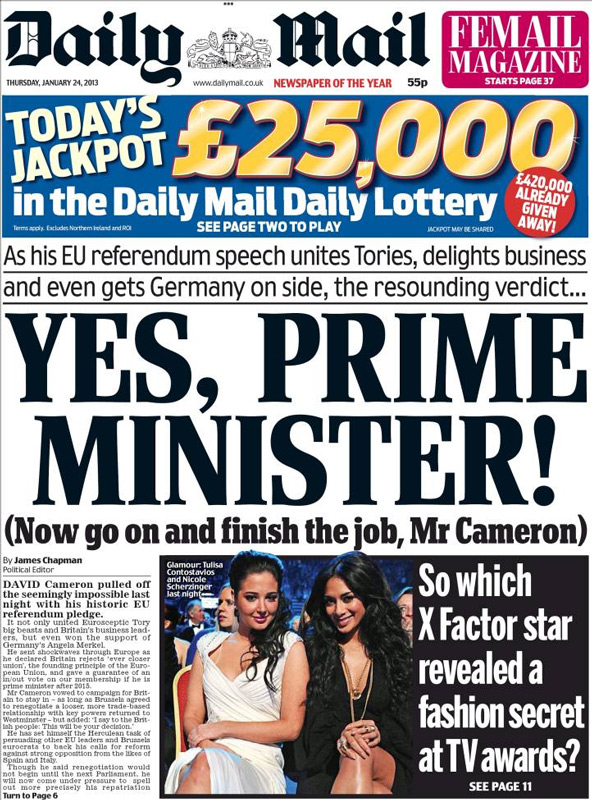
In his long-awaited speech on Europe, British PM David Cameron pledged to organise a referendum on UK membership of the EU if he’s re-elected in 2015. This referendum would be held before the end of 2017 and after a new deal is agreed between the UK and its EU partners.
This speech “unites Tories, delights business and even gets Germany on side”, writes the eurosceptic daily, referring to the fact that German Chancellor Angela Merkel said she was “prepared to talk about British wishes”.
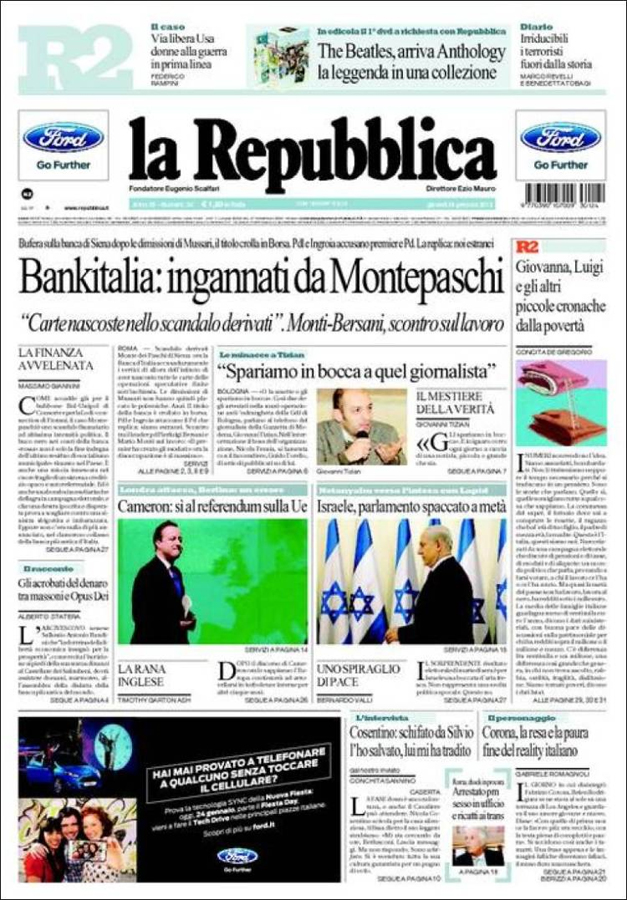
The Bank of Italy has accused the nation’s third largest bank, Monte dei Paschi, of providing false documentation about its crisis, which was triggered by calamitous derivative operations under former chairman Giuseppe Mussari (2006-2010).
On Tuesday, Mussari resigned from the presidency of the Italian Banks Association and yesterday, trading in the Siena bank’s shares was suspended after their value dropped 9 per cent.
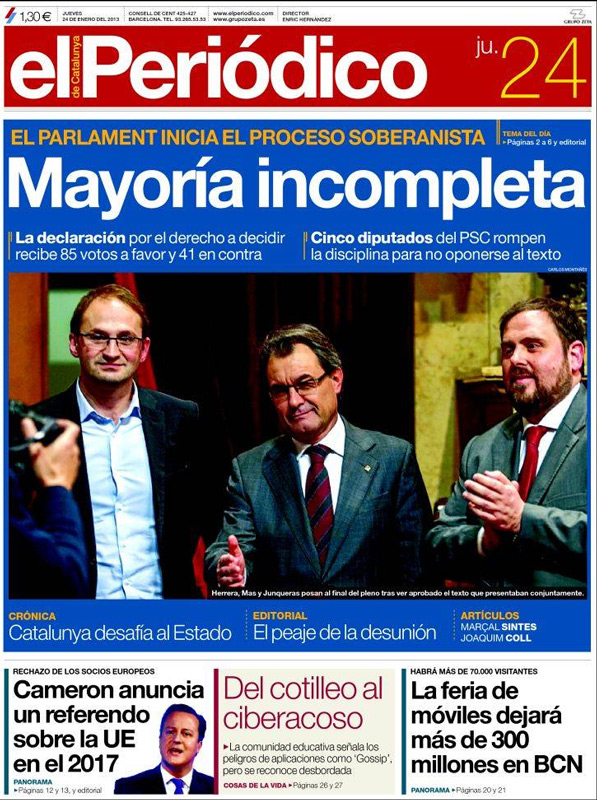
The Catalonia Parliament passed a declaration on Wednesday which classes the region as “a political and judicial sovereign subject”, a first step to organising a self-determination referendum in 2014.
A total of 85 representatives out of 135 voted in favour and 41 voted against. Among the latter, five of the 20 Socialist’s Party of Catalonia’s representatives disobeyed party instructions by not participating to the vote.
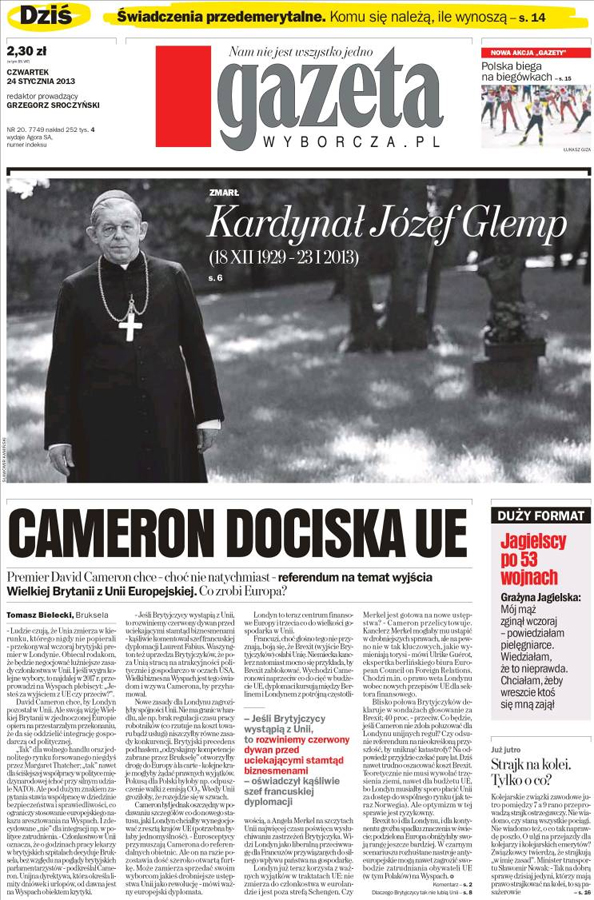
Announcing a referendum on the UK’s EU membership, British Prime Minister David Cameron promotes an outdated belief that you can separate economic from political integration, says GW.
This vision says “yes to free trade and the single market” and „even to closer cooperation on international policy (however with strong NATO participation). But it puts a big question mark over cooperation in the sphere of security and justice,” notes the Warsaw daily.
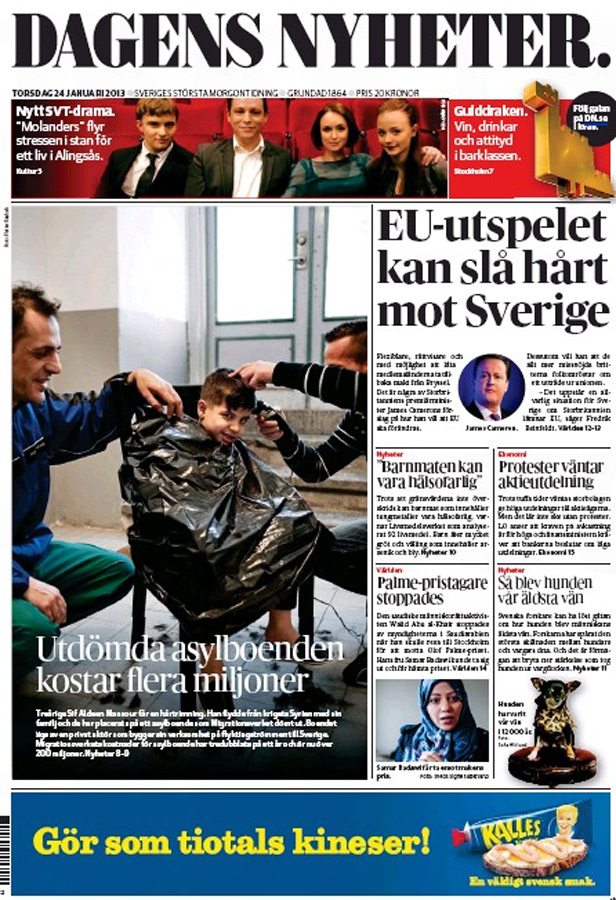
In the wake of the referendum announced on January 23 by David Cameron, Britain’s possible exit from the European Union could put an end to Swedish nationals’ access to the British labour market.
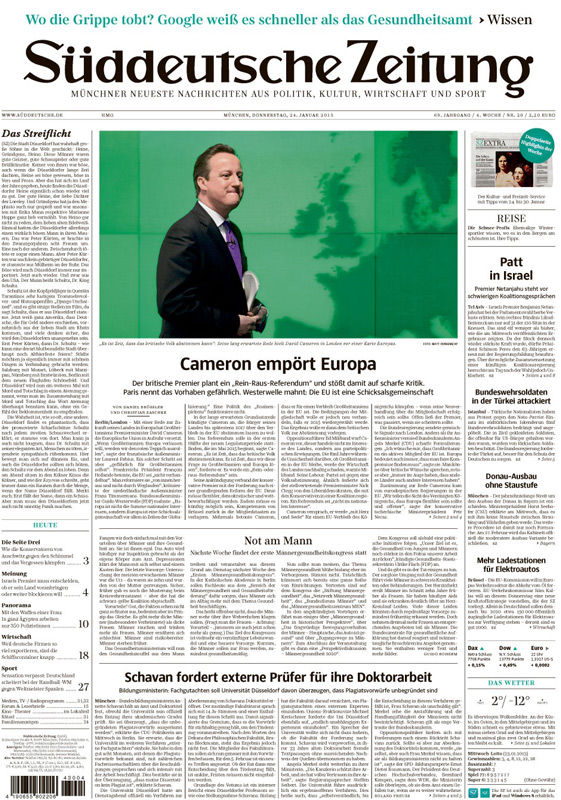
European foreign ministries were at boiling point in the wake of the speech by the British Prime Minister. In Paris, French Foreign Minister Laurent Fabius said that if the United Kingdom wished to leave Europe, France would roll out a red carpet to British businessmen. His German counterpart, Guido Westerwelle, took the view that a “cherry-picking policy“ is not workable.
România libera, Bucharest – We have freedom of movement, freedom of information and freedom of speech, but we are prisoners of a disdain for our language and culture, which is feeding illiteracy, complains a Romanian historian and writer. See more.
The amnesty decreed by outgoing President Václav Klaus on January 1 „is unconstitutional,“ says Czech financial daily Hospodářské noviny, commenting on a ruling by the Prague city court that the decree violates the Czech Constitution. The court said that Klaus announced the decree on the anniversary of the division of Czechoslovakia without discussing it previously with the cabinet. The measure is controversial because, among the 7,000 prisoners pardoned, some are responsible for corruption during the privatisation of considerable government assets during the 1990s, following the collapse of the Soviet Union.
„The amnesty is another step towards saving crooks,“ argues the weekly Respekt, which notes the agreement reached in 1998 between conservative then-Prime Minister Václav Klaus, and the head of the Left opposition at the time – and current candidate for president – Miloš Zeman and which –
practically halted any wish the police or the judiciary might have had to investigate cases of corruption during the privatisation process.
The controversial „Klaus“ amnesty should nonetheless be cancelled,“ says Hospodářské noviny because both Zeman and Karel Schwarzenberg, the two candidates facing off in the January 25-26 runoff for the presidential election, agree on this point.