La Repubblica, Rome – Remarkably for a Nobel Peace Prize laureate, Europe has been at war for close to 15 years: in the Balkans, in Afghanistan, in Libya, and today in the Sahel. However, an Italian editorialist argues, European intervention has consistently been marked by an absence of long-term vision. See more.
Expresso, Lisbon – Cartoon. See more.
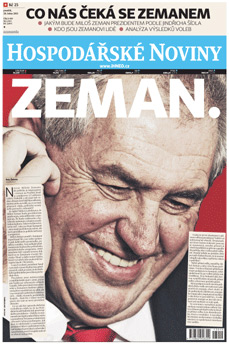
On January 26, the country’s former social-democratic prime minister, Miloš Zeman, was elected President of the Czech Republic with 54.8 per cent of the vote, defeating conservative Karel Schwarzenberg (45.2 per cent).
The Czech Republic’s third president since the Velvet Revolution, following on from Václav Havel and Václav Klaus, will be sworn in on March 8. According to the daily, he intends to surround himself with controversial advisors with links to the business world, and supports a plan for early general elections.
La Stampa, Turin – Founded in 1472, the bank Monte dei Paschi di Siena has helped raise Siena's quality of life and governance to the top tier. The political and economic scandal that has erupted around the “MPS”, however, could mark the end of a system – and of an era. See more.
Editorial
This week we were presented with what was in many ways a condensed history of the construction of Europe played out over two days. On January 22, there were celebrations to mark the 50th anniversary of the Elysée Treaty between France and Germany. A day later, David Cameron delivered his speech on relations between the United Kingdom and the EU.
It may be tempting to contrast the righteous Franco-German tandem and guarantor of the spirit of the Europe, as presented on the occasion of the Nobel Peace Prize award, with a “bad” British partner solely interested in the advantages of the European single market, but it would be a mistake to make such a comparison, because the two events that we have just witnessed are also emblematic of future challenges for the EU, which is faced with a reality that it is more subtle than it appears.
Rocked by the euro crisis, the growing economic gap between their two countries and the personal and political differences of their two leaders, Germany and France celebrated half a century of entente without defining a clear perspective for the future. Angela Merkel and François Hollande were eager to demonstrate their shared goodwill, which, although it continues to be essential for Europe, is no longer sufficient to provide the basis for a new project.
In London, the British Prime Minister called for a “new agreement” with the EU and announced that a referendum on the UK’s continued membership of the EU would be held after negotiations. In invoking the possibility of a British exit from the EU, David Cameron has displayed a willingness to strong-arm his European partners, but he has also put his own back to the wall. The existential crisis that he is intent on precipitating in the Union will also be an opportunity for the EU to affirm what it really wants to be. And the fact that a major initiative to redefine the European project should begin with Britain is not as paradoxical as it might seem, because as an outsider, the UK is in a unique position to challenge Europe’s taboos.
Of course, the British Prime Minister is not planning on entering into negotiations until after UK elections in 2015, and it is quite possible that he will not be re-elected and that the talks will never be held. However, even if this proves to be the case, Eurosceptic pressure is not about to disappear in 2015, and there is no guarantee that a newly returned British Labour government would be more conciliatory. Thus, the temptation to play for time and to avoid the questions posed by David Cameron should be avoided.
The eurozone crisis has raised the following issue: to save the single currency and safeguard the European economy, the EU will have to make progress towards political integration: however, it is an integration that will only concern 17 of the EU’s 27 members, which are eurozone states. In short, it appears that the requirement for a (mini) federal leap forward will definitively establish a multi-speed Europe — a contradiction no one has yet been able to resolve.
David Cameron is proposing that the EU adopt “a structure that can accommodate the diversity of its members. Some of whom are contemplating much closer economic and political integration.” A federation or an à la carte Europe? This is a choice that the EU has faced for 20 years, and it is high time that it came to a decision.
If it wants to make sense and to be a driving force in European policy, the Franco-German tandem will have to take up the gauntlet laid down by Cameron. But it cannot and should not attempt to do so alone. Although indispensable, the Paris-Berlin axis is not sufficient for such a task. The bid to confront this challenge should involve the widest possible circle of member states, and in particular countries like Italy, Spain and Poland. It will also have to transcend differences between founder members and the most recent recruits to the Union, between eurozone and non-eurozone members, between East and West and between North and South.
Even if the British referendum is never held, the question of the United Kingdom’s membership has been clearly posed. A failure to acknowledge its presence on the table of the European Council will have fatal consequences. The British, who are insisting that the single market should be “at the heart” of their relationship with the EU, should say if they are really ready to leave, and to face all of the inconveniences enumerated by their prime minister’s speech. For their part, Britain’s EU partners should be clear about the extent of their commitment to keep the British in Europe, or about what they foresee for a European power without Britain.
Political organisation, historical purpose, economic action: the changes implied by the British challenge are also those on which the current crisis has invited us to reflect. Now they have been linked to the imposing question of the unprecedented departure of a member state. Celebrating the past in Oslo and Berlin will serve no purpose if we are unable to tackle them.
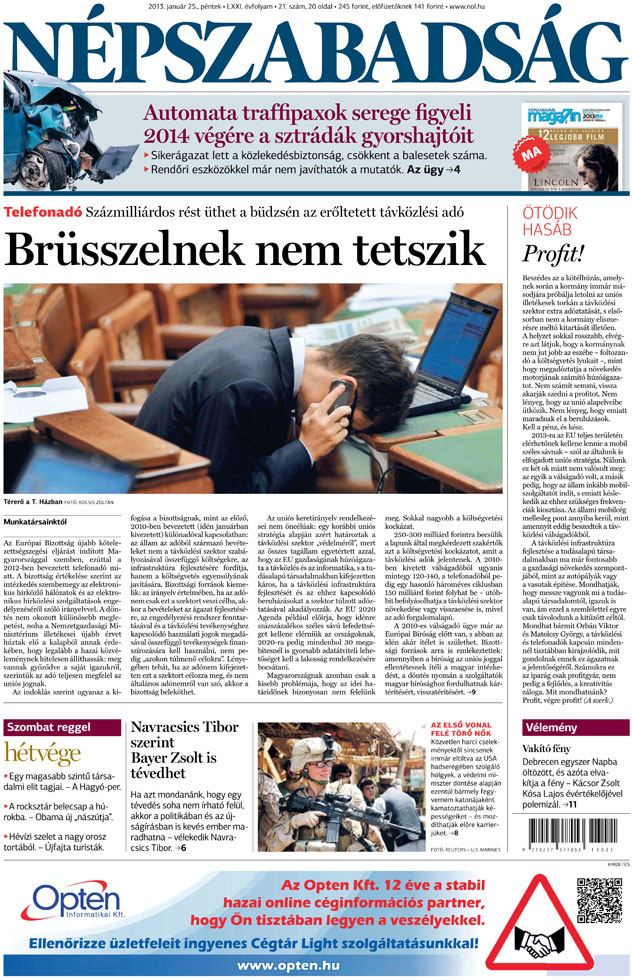
The tax on telephone calls passed in May 2012 by the Budapest parliament, which came into force on January 1, “does not please Brussels,” headlines Népszabadság. The European Commission has indeed begun infringement proceedings against Hungary by sending the government of Viktor Orbán a letter of formal notice on January 24. This can lead to proceedings before the European Court of Justice and to sanctions explains the daily.
In 2011 the European Commission opened an investigation into the “crisis tax” brought in by the Hungarian government in October 2010, the newspaper explains. These exceptional measures target the energy, telecommunications, retail and financial sectors. Due to expire in 2013, they have been extended sine die. Hungary’s government has two months to respond to the remarks from Brussels or to bring its legislation into line with European Union law.
The Guardian, London – The spirit of dictators like Nicolae Ceauşescu is finding new life in the response of the European elite to the eurozone crisis, says Slovenian thinker Slavoj Žižek. The same distrust of democracy that once constrained the developing or the post-communist countries is now gaining ground in Europe. See more.
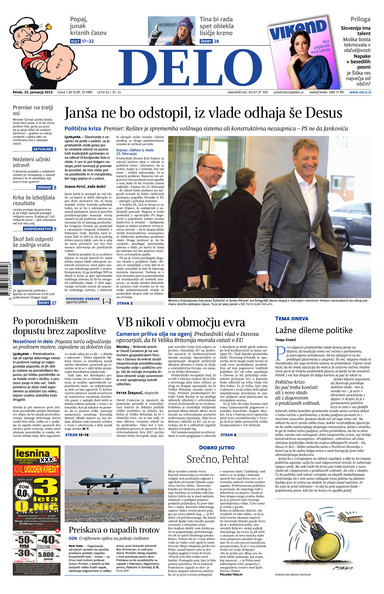
Prime Minister Janez Janša has announced that he will not step down, in spite of the resignation, on Thursday, of Finance Minister Janez Šušteršič and Justice Minister Senko Pličanič. Both men resigned in the wake of the previous day’s decision by their Civic List party to leave the ruling coalition.
Another member of the ruling coalition, the pensioner’s party, DeSUS, has demanded that Janša resign, and threatened to also withdraw from the government on February 22. Janša has said that he will only resign if he loses a vote of no confidence, or following the formation of an alternative majority in parliament.
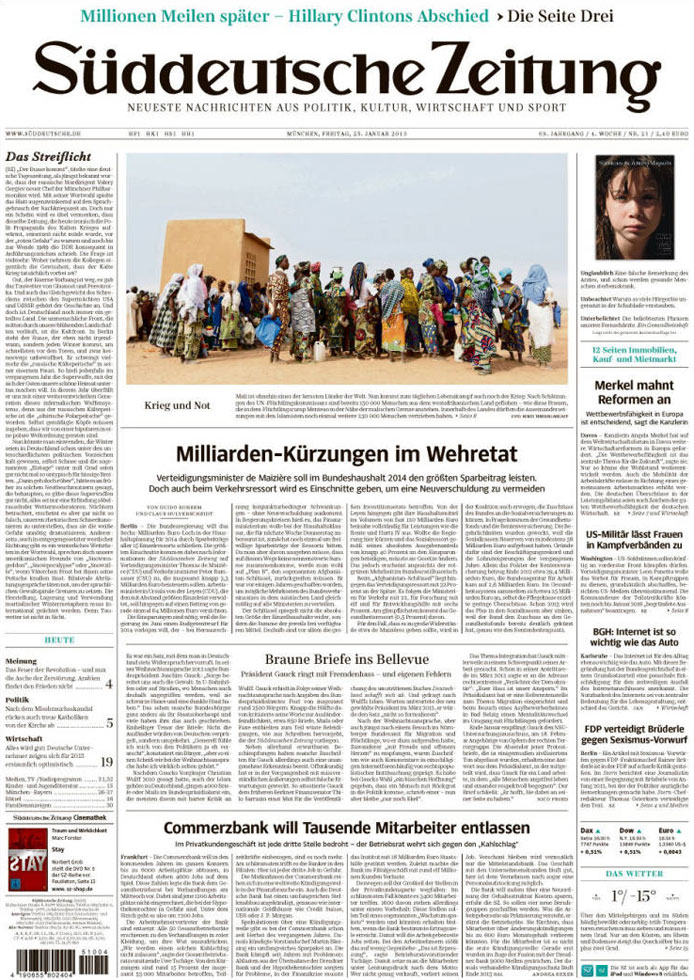
In its 2014 budget, the German government is planning to cut spending by €6bn to avoid taking on any new debt. The Ministry of Defence, followed by the Ministry of Transport, will be hardest hit by the belt-tightening measures, at a time when questions are being asked about the scale of Germany’s intervention alongside French forces in Mali.
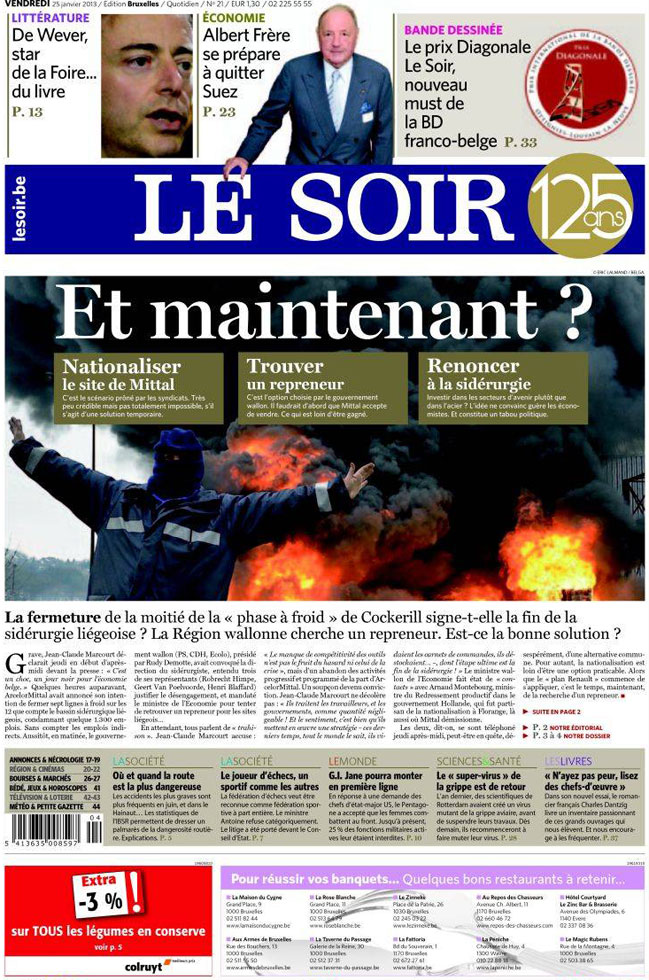
On January 24, steelmaker ArcelorMittal announced its intention to close six finishing lines and a coke plant in the Liège basin, which will effectively axe 1,300 jobs, and further undermine the region’s labour market. Liège has already been hit by 800 redundancies from the closure of two blast furnaces, announced in October 2011.
Staff at the steelworks have called for a strike to protest against the decision.