
New Eastern Europe, Cracow – Ahead of the end of immigration controls on Romania and Bulgaria in January 2014, some UK ministers are thinking of running a campaign to deter a repeat of the 2004 “wave” of immigration when eight former communist countries gained EU working rights. But the eurozone crisis makes this prospect less likely. See more.

According to the International Monetary Fund, the economic outlook for Hungary will remain „difficult“ in 2013. On January 28 in Budapest, the IMF concluded a two-week joint mission with the Commission to analyse the state of Hungary’s public finances, with a view to granting a loan for €15bn, which was solicited by Budapest in the summer of 2012.
The IMF acknowledged a „significant“ reduction in Hungary’s budget deficit, but remarked that the means used to achieve it — stopgap measures like tax hikes for individuals and companies, especially foreign companies, — had damaged the climate for investment.

German Environment Minister Peter Altmeier wants to counter the steep increase in electricity prices prompted by the government’s pro-renewables energy policy. The law on the promotion of alternative energies has boosted the use of renewables from 8 to 23 per cent of power production. However, taxes paid by consumers to finance wind and solar development are expected to reach €20bn in 2013.
In the run-up to elections this year, the minister wants to freeze the tax to prevent a reductive focus on the cost to households from distorting the debate on renewables. The green energy sector has denounced the move as a “a fatal blow”.

Former finance minister and leader of the liberal Venstre opposition party, Claus Hjort Frederiksen, has warned against China’s ambitions in Greenland. In recent months, several Chinese companies have begun exploration projects or negotiations with a view to operating — either independently or in partnership with Western companies — mineral mines on the island.
“Mining operations are a means, and not an end,” remarked Claus Hjort Frederiksen in an interview with the daily. He further confirmed that Beijing’s real objective is to gain a foothold in the Arctic”, citing Beijing’s application for observer membership of the Arctic Council.

Finance Minister Luis de Guindos has indicated that he may be willing to review deficit targets for Spain’s regions, if the European Commission will consent to lower deficit targets for the Spanish state in 2013.
A more attainable deficit target is one of the “key demands” of the Catalan regional government, notes the Barcelona daily. De Guindos was speaking on the occasion of a Madrid meeting with EU Economic and Monetary Affairs Commissioner Olli Rehn. For his part, Rehn insisted on the need to persevere with reforms to fight unemployment, which now affects 26 per cent of Spain’s working population.
La Repubblica, Rome – Remarkably for a Nobel Peace Prize laureate, Europe has been at war for close to 15 years: in the Balkans, in Afghanistan, in Libya, and today in the Sahel. However, an Italian editorialist argues, European intervention has consistently been marked by an absence of long-term vision. See more.
Expresso, Lisbon – Cartoon. See more.
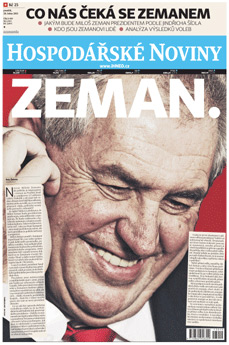
On January 26, the country’s former social-democratic prime minister, Miloš Zeman, was elected President of the Czech Republic with 54.8 per cent of the vote, defeating conservative Karel Schwarzenberg (45.2 per cent).
The Czech Republic’s third president since the Velvet Revolution, following on from Václav Havel and Václav Klaus, will be sworn in on March 8. According to the daily, he intends to surround himself with controversial advisors with links to the business world, and supports a plan for early general elections.

In 2003, two murderers who were members of the extreme right terrorist cell National Socialist Underground Uwe Mundlos and Uwe Böhnhardt spent time in the capital of Baden-Württemberg where they identified targets. According to documents consulted by the daily, police found photographs of the owners of a Turkish café and a Turkish grocery following an explosion at an NSU house in 2011.

From 2008 to 2011, ArcelorMittal Finance, which is registered in Belgium, generated profits of €5.8bn. However, because the steel group’s “internal bank” is “hypercapitalised” (€28bn of capital between 2008 and 2010, and €36.6bn in 2011), it was able to take advantage of “notional interest deduction”, a specifically Belgian tax break that allows companies to avoid tax if they invest using their own resources.
Over four years, the group’s “internal bank” deducted €5.6bn: ArcelorMittal was only obliged to pay tax for one year (€81mn in 2008). This amounted to an overall tax rate of 1.4 per cent from 2008-2011.